In the heart of Tuscany

ROMANESQUE CHURCHES OF CASENTINO
Distance from Villa Catarsena: 12 km (Pieve a Socana)
The Casentino Parish Churches Many parish churches still existing today date back to the Romanesque period, and arose along the two ancient medieval roads: the Via Flaminia Maior (which from Arezzo, roughly along the Arno River, crossed the Casentino) and the Via Flaminia Minor (which split from the Via Flaminia Maior around Poppi and continued along the Consuma, passing through Strada and other towns up to Montemignaio).
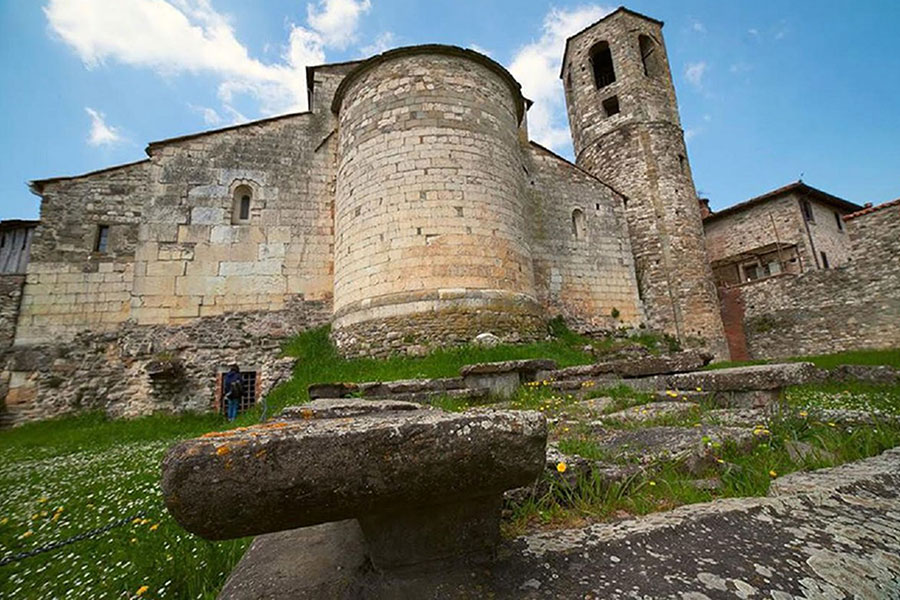
Pieve a Socana Many Casentino parish churches were rebuilt over pre-existing places of worship. The parish church that best represents this idea is that of Sant’Antonino a Socana, an important place of worship since Etruscan times, as evidenced by the sacrificial altar discovered behind the church, one of the most impressive in Europe.
Santa Maria a Buiano The parish church of Santa Maria a Buiano, a few kilometers from the town of Poppi, stands on a pre-existing Roman building.
It is recorded since 1001 and entrusted by Emperor Frederick I to the benefice of the Abbey of Capolona. It has been severely altered and reduced to a single nave, but originally it must have had three naves, each ending in an apse, and entirely covered with trusses. The crypt, however, retains its original layout.
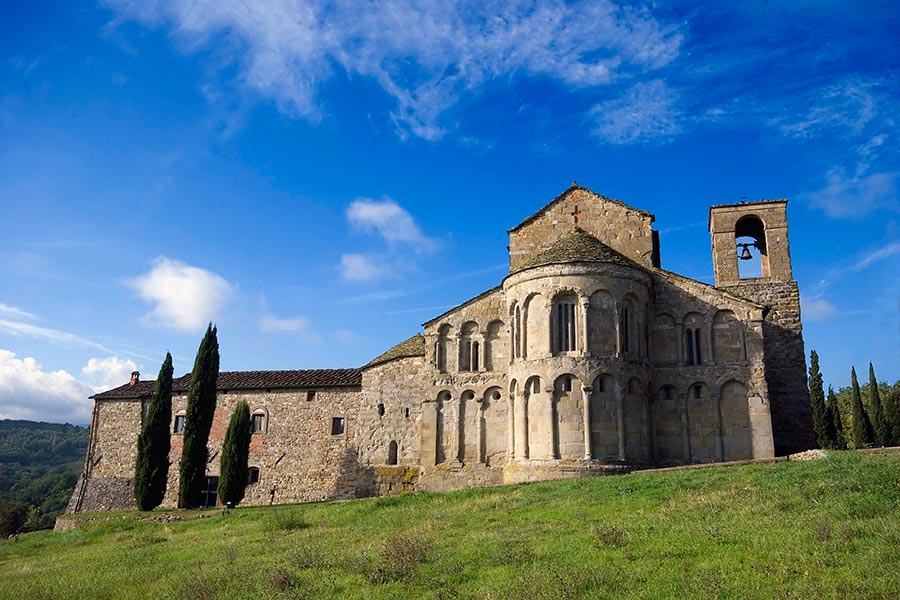
San Pietro a Romena The church of San Pietro a Romena, very close to the castle, and that of Santa Maria Assunta a Stia, in Piazza Tanucci, the town’s main square, are two beautiful examples of Romanesque parish churches in Casentino.
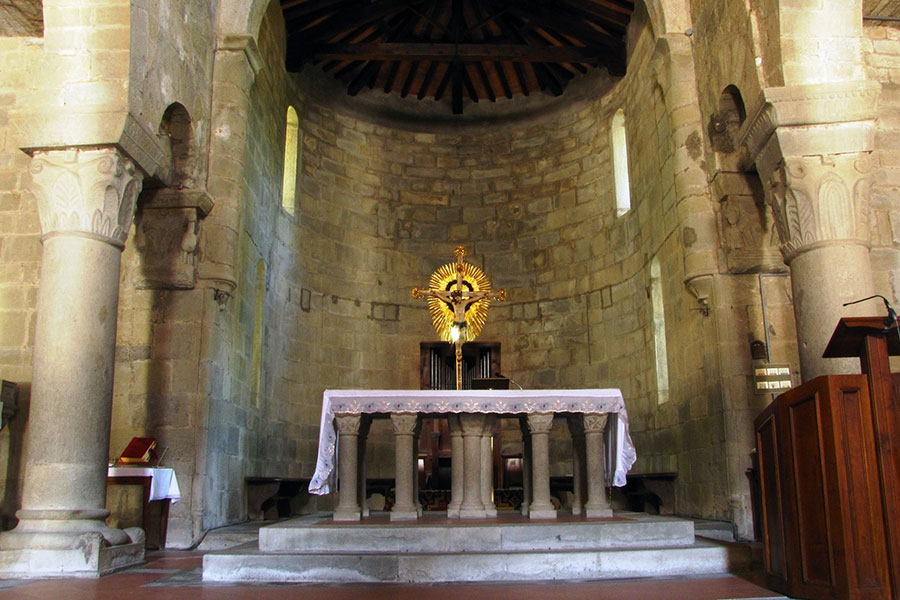
The capitals of the parish churches depict figures of saints, mermaids, and monsters from medieval bestiaries, along with animals and common naturalistic elements perhaps drawn from local fauna and flora, such as chestnut leaves. Although deteriorated by the elements and the centuries, the exterior decoration of the parish church of Romena is particularly evocative.
Santa Maria Assunta Stia Although first mentioned in 1017, the building we see today dates back to the late 12th century.
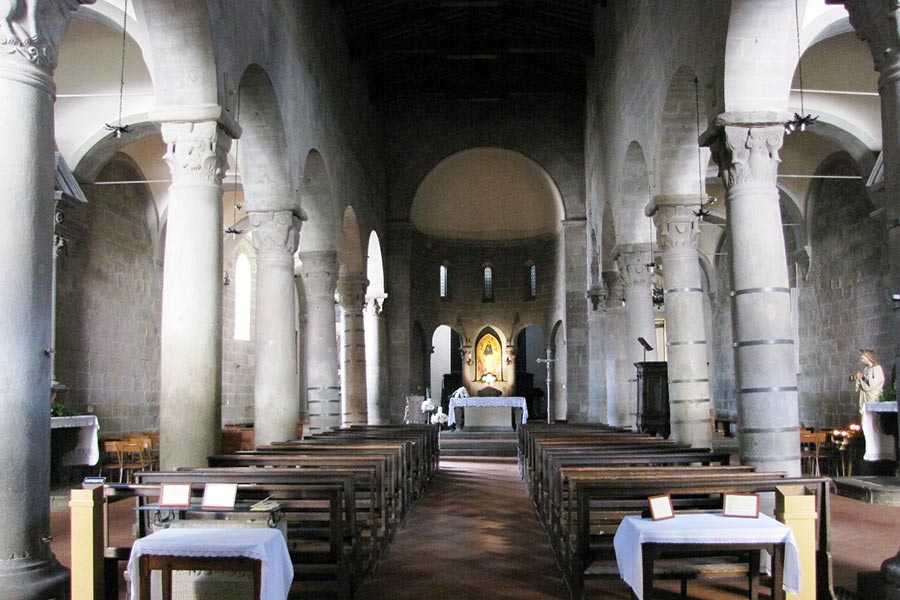
The parish church, with three naves divided by columns, was heavily transformed during the 18th century, when the façade and apse were rebuilt. Part of the original structure was recovered starting in 1974, the year in which the remains of a building preceding the Romanesque parish church, belonging to another place of worship, were discovered. The sirens, toga-wearing figures, corner telamons, parish priests, and bishops sculpted on the capitals recall those of the parish church of Romena.
Santa Maria Assunta in Montemignaio The parish church of Montemignaio is similar in style and layout to the other Casentino parish churches, and was most likely built by the same craftsmen.
The interior is highly evocative due to the combination of pillars and columns, the round arches separating the bays, and the remains of some frescoes still visible on some pillars that have deteriorated over the centuries.
Other churches to see In addition to the parish churches in Casentino, there are other places of worship rich in history and works of art to see. In Bibbiena, there are the parish church of Saints Hippolytus and Cassian, San Lorenzo, the 18th-century Oratory of San Francesco, and, nearby, the Sanctuary of Santa Maria del Sasso. In Poppi, there are also San Fedele, the 17th-century Oratory of the Madonna del Morbo, and, nearby, the remains of the Abbey of Strumi.
Bibbiena The parish church in the historic center of Bibbiena is named after Saints Hippolytus and Cassian, the saints to whom the first parish church, located outside the town in the “Il Castellare” area, was also dedicated, but was later destroyed. Inside the parish church, in addition to 14th-century frescoes, are many artistic furnishings, including a stunning Madonna and Child by the 15th-century master Arcangelo di Cola da Camerino.
San Fedele di Poppi The church of San Fedele is located in the historic center of Poppi. It is distinctive for its Gothic structure, its beautiful portal with capitals decorated with plant motifs, and the white and green colors of the arches near the transept.